
Canon EOS R8 Mark II: Features, Specs & Buying Guide
Nov
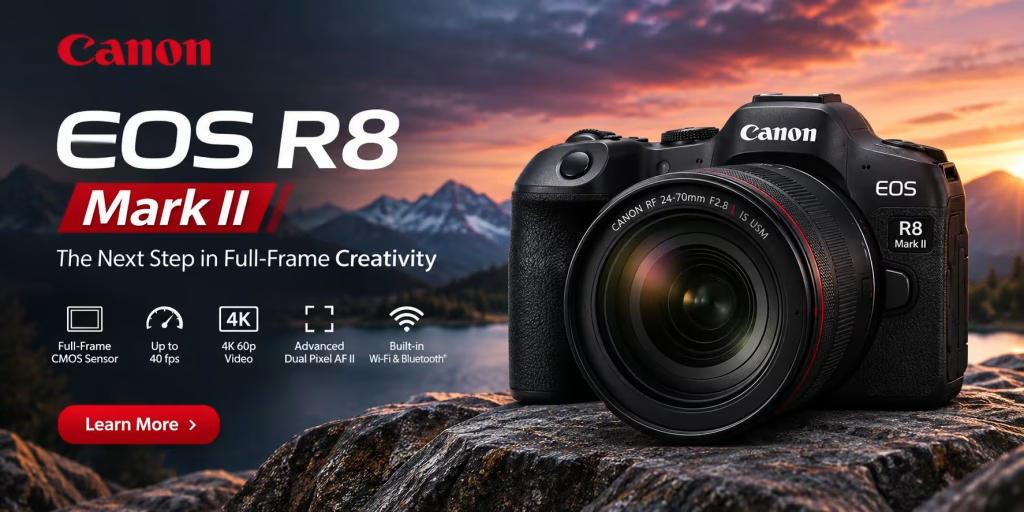
The Canon EOS R8 Mark II brings important improvements to Canon’s compact full-frame mirrorless camera lineup, combining a 24.2MP CMOS sensor, 5-axis in-body image stabilization, advanced autofocus and professional video features.
Announced in September 2026, the EOS R8 Mark II builds on the original EOS R8 with better handheld shooting capabilities, expanded creative controls and new tools for capturing fast-moving subjects.
For photographers, filmmakers, vloggers and content creators searching for a Canon EOS R8 Mark II in Lebanon, this camera offers an appealing balance of portability, full-frame image quality and hybrid performance.
But is it worth upgrading from the original EOS R8? And how does it compare with more advanced Canon cameras?
This guide explains the specifications, real-world benefits, differences and buying considerations to help you choose the right camera.
Canon EOS R8 Mark II: Quick Overview
The Canon EOS R8 Mark II is a compact full-frame mirrorless camera designed for photographers and video creators who want professional features without carrying a large camera body.
- Sensor: 24.2MP full-frame CMOS.
- Processor: Canon DIGIC X.
- Image Stabilization: 5-axis IBIS, up to 7.5 stops with compatible equipment under Canon’s test conditions.
- Autofocus: Dual Pixel CMOS AF II with advanced subject detection.
- Continuous Shooting: Up to 40 fps electronic shutter.
- Pre-Continuous Shooting: Captures up to 20 frames before the shutter is fully pressed.
- Video: Uncropped 6K-oversampled 4K up to 60p.
- Slow Motion: Full HD up to 180 fps.
- Video Profiles: Canon Log 3 and supported 10-bit recording formats.
- Lens Mount: Canon RF.
- Body Weight: Approximately 499 g without battery and card.
Explore the Canon EOS R8 Mark II Mirrorless Camera at DSLR Zone Lebanon for current product details and availability.
1. 24.2MP Full-Frame CMOS Sensor: What Does It Offer?
At the heart of the Canon EOS R8 Mark II is a 24.2-megapixel full-frame CMOS sensor paired with Canon’s DIGIC X image processor.
The sensor measures approximately 36 × 24 mm, providing a larger imaging area than typical APS-C cameras.
Full-Frame Image Quality
A full-frame sensor offers several practical advantages, depending on the lens and shooting conditions:
- Flexible depth-of-field control.
- Strong potential for low-light photography.
- Detailed photographs suitable for professional editing.
- Wide-angle framing with compatible full-frame lenses.
- Creative background separation for portraits.
The camera supports a standard still-photo ISO range of 100–102,400, giving photographers flexibility when working in different lighting environments.
Is 24.2MP Enough for Professional Photography?
For many photographers, 24.2MP is sufficient for portraits, events, travel, product photography and digital content.
It provides enough resolution for detailed images while keeping file sizes more manageable than significantly higher-resolution cameras.
However, photographers who regularly need extensive cropping or very large prints may benefit from a higher-resolution body.
2. New 5-Axis IBIS: One of the Biggest Upgrades
One of the most significant improvements over the original Canon EOS R8 is the addition of in-body image stabilization, commonly called IBIS.
The original EOS R8 does not include sensor-shift IBIS, while the R8 Mark II uses a 5-axis stabilization system.
What Is IBIS?
In-body image stabilization compensates for certain types of camera movement by adjusting the image sensor’s position.
This can help reduce blur caused by handheld camera shake.
Up to 7.5 Stops of Stabilization
Canon specifies up to 7.5 stops of stabilization at the image center with compatible lenses under defined testing conditions.
The actual benefit varies according to the lens, focal length, shooting technique and conditions.
When Is IBIS Useful?
- Handheld photography in low light.
- Travel and street photography.
- Indoor events.
- Using lenses without optical stabilization.
- Reducing certain types of handheld video movement.
IBIS helps compensate for camera shake, but it cannot freeze a moving subject. Fast action may still require a faster shutter speed.
Buying tip: If you frequently shoot handheld without a tripod, IBIS is one of the strongest reasons to consider the R8 Mark II instead of the original R8.
3. Up to 40 fps Continuous Shooting and Pre-Capture
The Canon EOS R8 Mark II supports high-speed continuous shooting at up to approximately 40 frames per second using its electronic shutter.
This makes it suitable for capturing fast-changing moments such as sports, wildlife, pets and event photography.
What Is Pre-Continuous Shooting?
Pre-continuous shooting helps capture moments that happen before you fully press the shutter button.
The EOS R8 Mark II can save up to 20 frames from the period immediately before the full shutter press, depending on the selected settings.
This is particularly useful when photographing unpredictable action.
Examples of When Pre-Capture Helps
- A bird suddenly taking flight.
- A football player making a decisive move.
- A child jumping or running.
- A pet making an unexpected movement.
- A brief expression during an event.
Important: The original EOS R8 already supports up to 40 fps electronic shutter shooting. The major improvement in the Mark II is the addition of pre-continuous shooting and an expanded burst buffer, not a higher maximum burst rate.
Actual burst performance depends on camera settings, lens compatibility, lighting and memory card performance.
4. Dual Pixel CMOS AF II: Smarter Subject Tracking
The EOS R8 Mark II uses Canon’s Dual Pixel CMOS AF II autofocus system with intelligent subject recognition.
It can detect and track different types of subjects, helping photographers maintain focus during changing compositions.
People, Animals and Vehicles
Supported autofocus detection includes:
- People and faces.
- Eyes and other supported subject details.
- Animals.
- Vehicles.
Register People Priority
One of the important additions is Register People Priority.
This feature allows photographers to register specific people so the camera can prioritize them when multiple faces are present.
For example, a wedding photographer may want to keep the bride or groom as the main focus even when other guests enter the frame.
Improved Autofocus Controls
The EOS R8 Mark II also introduces a multi-controller joystick for more convenient autofocus point selection.
These changes can improve handling for photographers who frequently switch subjects or work in busy environments.
5. Canon EOS R8 Mark II Video: 4K 60p and 10-Bit Recording
The Canon EOS R8 Mark II is designed for hybrid creators who need both high-quality photographs and flexible video recording.
Uncropped 4K 60p Video
The camera supports UHD 4K video at up to 59.94 fps, oversampled from approximately 6K capture.
This allows detailed 4K footage while retaining the full-frame angle of view in supported uncropped recording modes.
That is especially useful for:
- YouTube videos.
- Interviews.
- Travel filmmaking.
- Wedding highlights.
- Commercial content.
- Social media video production.
10-Bit Video and Canon Log 3
Supported recording formats include 10-bit 4:2:2 options, giving creators more flexibility when editing and color grading.
Canon Log 3 provides a flatter image profile intended for post-production workflows.
Not every recording mode uses the same codec, color sampling or bit depth, so choose the settings that match your editing workflow.
Full HD 180 fps Slow Motion
The camera also supports Full HD recording at up to approximately 180 fps.
This can be useful for slow-motion footage of movement, action and creative details.
Additional Video Features
- XF-HEVC S and XF-AVC S recording options.
- Slow & Fast Motion modes.
- Look File support for compatible LUT workflows.
- Custom Picture settings.
- Microphone input.
- Headphone output.
- USB-C connectivity and supported streaming workflows.
Recording duration depends on battery power, card capacity, temperature and selected recording settings.
6. Canon EOS R8 Mark II vs EOS R8: What’s the Difference?
The original Canon EOS R8 remains a capable full-frame mirrorless camera.
Both models use an approximately 24.2MP full-frame sensor and Canon DIGIC X processing.
The Mark II focuses on additional stabilization, improved controls and expanded creative features.
| Feature | EOS R8 Mark II | EOS R8 |
|---|---|---|
| Sensor | 24.2MP Full-Frame | 24.2MP Full-Frame |
| Processor | DIGIC X | DIGIC X |
| In-Body Stabilization | Yes, 5-axis | No |
| Electronic Burst | Up to 40 fps | Up to 40 fps |
| Pre-Continuous Shooting | Yes | No equivalent mode |
| Register People Priority | Yes | No |
| 4K Video | Up to 60p | Up to 60p |
| Canon Log 3 | Yes | Yes |
| Look File Support | Yes | No |
| Weight With Battery & Card | Approx. 546 g | Approx. 461 g |
Choose Canon EOS R8 Mark II If…
- You want built-in image stabilization.
- You frequently shoot handheld.
- You photograph unpredictable action.
- You want Register People Priority autofocus.
- You need additional creative video controls.
Choose Canon EOS R8 If…
- You want a lighter full-frame camera.
- Your budget is more limited.
- You already use stabilized lenses or a tripod.
- You do not need the additional autofocus and pre-capture features.
Compare the original Canon EOS R8 Mirrorless Camera at DSLR Zone before deciding whether to upgrade.
7. Canon EOS R8 Mark II vs EOS R6 Mark III
Buyers comparing Canon full-frame cameras may also consider the more advanced EOS R6 Mark III.
The R8 Mark II prioritizes compactness and portability, while the R6 Mark III offers a higher-resolution sensor and additional professional capabilities.
EOS R8 Mark II Advantages
- Smaller and lighter body.
- 24.2MP full-frame image quality.
- Advanced autofocus and IBIS.
- Strong 4K video capabilities.
- A practical option for travel and hybrid creators.
EOS R6 Mark III Advantages
- Higher-resolution 32.5MP full-frame sensor.
- More advanced video recording options.
- Dual memory card slots.
- Additional professional-oriented capabilities.
For professional event photographers who require in-camera backup recording, the R6 Mark III’s dual-card design may be an important advantage over the R8 Mark II’s single SD slot.
Explore the Canon EOS R6 Mark III at DSLR Zone Lebanon for a higher-tier alternative.
8. Best Lenses for Canon EOS R8 Mark II
The Canon EOS R8 Mark II uses the Canon RF lens mount.
Choosing the right lens can have a major effect on image quality, framing, low-light performance and the types of photographs you can capture.
Canon RF 24-105mm f/4-7.1 IS STM — Everyday Versatility
The Canon RF 24-105mm f/4-7.1 IS STM covers a useful range from wide-angle scenes to short telephoto framing.
It can be a practical choice for travel, family photography and everyday use.
Canon RF 50mm f/1.8 STM — Portraits and Low Light
The Canon RF 50mm f/1.8 STM is a compact prime lens with a wide maximum aperture.
It is suitable for portraits, street photography and creative depth-of-field effects.
What About Other Canon Lenses?
The EOS R8 Mark II supports compatible Canon RF lenses. Certain EF lenses can also be used with a suitable Canon EF-EOS R mount adapter.
RF-S and EF-S lenses can be used in a cropped imaging area, reducing the effective image resolution compared with full-frame capture.
Explore the camera lenses collection at DSLR Zone or read our Best Camera Lenses in Lebanon guide to understand focal lengths, apertures and lens selection.
9. Is the Canon EOS R8 Mark II Good for Wedding Photography?
The Canon EOS R8 Mark II has several features that make it attractive for wedding and event photography.
- Full-frame image quality.
- Advanced people detection.
- Register People Priority autofocus.
- High-speed continuous shooting.
- In-body image stabilization.
- Compact body for long shooting sessions.
Register People Priority can be especially helpful when photographing a specific person in a busy environment.
However, professional wedding photographers should carefully consider the single memory card slot.
If redundant in-camera recording is essential to your workflow, a camera with dual card slots may be more suitable.
10. Is Canon EOS R8 Mark II Good for YouTube and Content Creation?
Yes. The camera’s combination of full-frame imaging, 4K60 video, advanced autofocus and a vari-angle touchscreen makes it suitable for many content creation workflows.
For YouTube Creators
The camera can record detailed 4K video and offers subject tracking for presenters who move during recording.
For Interviews and Podcasts
The microphone input and headphone output support more controlled audio recording setups.
For Travel Content
Its compact body and in-body stabilization can make it more convenient to carry and use handheld.
For Professional Video Work
Canon Log 3, supported 10-bit recording and additional video controls provide flexibility for color grading and post-production.
For a complete creator setup, explore photography accessories at DSLR Zone, including tripods, microphones, lighting and camera support equipment.
11. Canon EOS R8 Mark II Technical Specifications
| Model | Canon EOS R8 Mark II |
|---|---|
| Product SKU | 7503C002 (Body Only) |
| Sensor | 24.2MP Full-Frame CMOS |
| Processor | DIGIC X |
| Lens Mount | Canon RF |
| Image Stabilization | 5-Axis IBIS, up to 7.5 stops under specified conditions |
| ISO | 100–102,400 standard for stills |
| Autofocus | Dual Pixel CMOS AF II |
| Burst Shooting | Up to 40 fps electronic shutter |
| Pre-Continuous Shooting | Up to 20 frames before full shutter press |
| Video | UHD 4K up to 60p, Full HD up to 180p |
| Video Formats | XF-HEVC S / XF-AVC S |
| Color Profiles | Canon Log 3, supported HDR and Custom Picture options |
| Screen | 3-inch Vari-Angle Touchscreen |
| Memory Card | Single SD UHS-II-compatible slot |
| Connectivity | USB-C, Micro-HDMI, Microphone and Headphone Jacks |
| Wireless | Wi-Fi 6, Bluetooth 5.3 |
| Battery | Canon LP-E17 |
| Weight | Approx. 499 g body only; 546 g with battery and card |
12. What Should You Buy With the EOS R8 Mark II?
If you are buying the body-only version, remember that a compatible lens is required for normal photography.
Depending on your workflow, consider:
- A compatible Canon RF lens.
- A suitable SD memory card.
- An additional compatible battery.
- A protective camera bag.
- A tripod or camera support.
- An external microphone for video.
The EOS R8 Mark II has a single UHS-II-compatible SD card slot, so select a memory card that meets the speed requirements of your chosen video recording format.
Explore SD memory cards and accessories at DSLR Zone Lebanon.
13. Is the Canon EOS R8 Mark II Worth Buying in 2026?
The EOS R8 Mark II is a strong option for buyers who want a compact full-frame camera with improved stabilization and additional creative features.
Its most meaningful advantages over the original EOS R8 include:
- Built-in 5-axis stabilization.
- Pre-continuous shooting.
- Expanded autofocus controls.
- Register People Priority.
- Improved handling.
- Additional creative video and color tools.
However, the original EOS R8 remains an excellent option for buyers who do not need these additions.
Photographers requiring dual card slots, higher resolution or more advanced professional recording options may prefer a higher-tier camera.
14. Where to Buy Canon EOS R8 Mark II in Lebanon
DSLR Zone lists the Canon EOS R8 Mark II Mirrorless Camera in its photography and digital camera collection.
The listed model is the body-only configuration, so a lens is not included.
Before ordering, confirm current pricing, stock or backorder status, included accessories and applicable after-sales terms.
You can also compare other digital cameras available at DSLR Zone Lebanon.
Frequently Asked Questions About Canon EOS R8 Mark II
When was the Canon EOS R8 Mark II announced?
Canon announced the EOS R8 Mark II in September 2026 as an updated compact full-frame mirrorless camera.
Does the Canon EOS R8 Mark II have IBIS?
Yes. The EOS R8 Mark II includes 5-axis in-body image stabilization, with up to 7.5 stops of correction under Canon’s specified test conditions.
Is the Canon EOS R8 Mark II better than the EOS R8?
The Mark II adds IBIS, pre-continuous shooting, enhanced autofocus controls and additional creative features. Both models share a similar 24.2MP full-frame imaging foundation.
Can Canon EOS R8 Mark II record 4K 60fps video?
Yes. The camera supports uncropped UHD 4K recording up to approximately 60p, oversampled from 6K, along with supported 10-bit recording formats.
Does Canon EOS R8 Mark II shoot 40fps?
Yes. It supports electronic shutter continuous shooting at up to approximately 40 fps under suitable conditions. The original EOS R8 also supports up to 40 fps.
Is Canon EOS R8 Mark II good for wedding photography?
It offers full-frame image quality, advanced autofocus and stabilization suitable for many wedding photography situations. However, professionals who require dual memory card recording should consider that it has only one SD slot.
Is Canon EOS R8 Mark II good for YouTube?
Yes. Its 4K60 video, subject-tracking autofocus, vari-angle screen and audio connections make it a capable option for YouTube and other video production workflows.
Which lenses work with Canon EOS R8 Mark II?
The camera uses the Canon RF mount. Compatible RF lenses work directly, while supported EF lenses require an appropriate mount adapter. RF-S and EF-S lenses use a cropped image area.
Does Canon EOS R8 Mark II have two memory card slots?
No. The EOS R8 Mark II has one SD memory card slot compatible with UHS-II cards.
Is a lens included with the Canon EOS R8 Mark II at DSLR Zone?
The DSLR Zone listing referenced in this guide is the body-only version. A compatible lens must be purchased separately unless you already own one.
Where can I buy Canon EOS R8 Mark II in Lebanon?
DSLR Zone lists the Canon EOS R8 Mark II for customers in Lebanon. Check the product page for current pricing, backorder status and purchasing details.
Final Verdict: Canon EOS R8 Mark II in Lebanon
The Canon EOS R8 Mark II improves on an already capable full-frame camera by adding features that matter for real-world photography and video production.
Its strongest upgrades are in-body image stabilization, pre-continuous shooting, expanded autofocus controls and additional creative video tools.
Choose the EOS R8 Mark II if: You want a compact full-frame camera with advanced stabilization and hybrid shooting capabilities.
Choose the original EOS R8 if: You want similar core image quality at a potentially lower cost and do not need the new features.
Consider the EOS R6 Mark III if: You need a higher-resolution sensor, dual card slots or more advanced professional video features.
For photographers and content creators in Lebanon, the EOS R8 Mark II offers a compelling combination of portability and versatility.
Explore the Canon EOS R8 Mark II at DSLR Zone Lebanon and check the latest price and availability.